
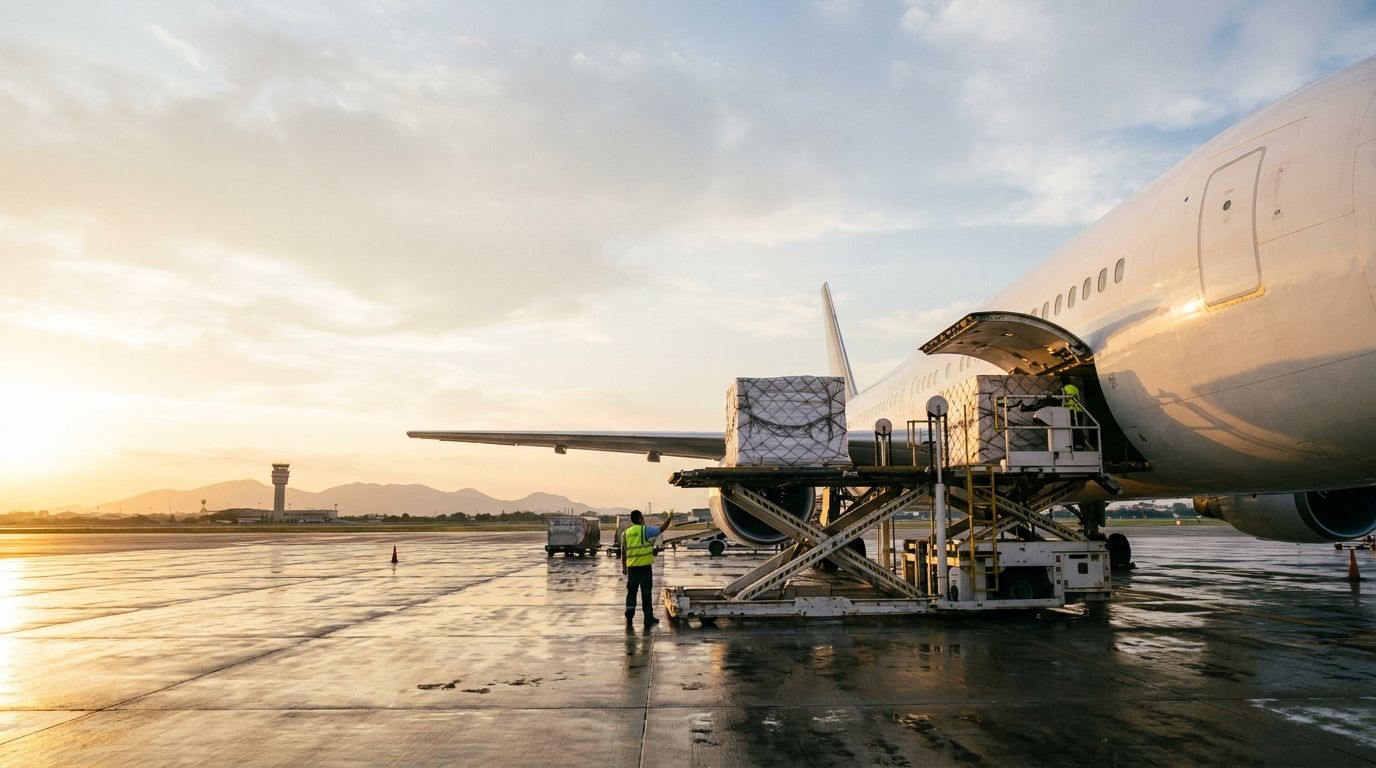







Cargo Aircraft Weight and Balance Calculation Method
We analyze how weight distribution affects flight safety, why dimensional data accuracy is critical for KAZLOGIST.KZ, and how weight and balance calculations protect your cargo.
Why a Logistician Needs to Understand Aircraft Balancing Principles
For a supply manager or business owner ordering air freight through KAZLOGIST.KZ, aircraft weight and balance might seem like a purely technical aspect concerning only pilots. However, in practice, errors in weight and dimensions data provided by the customer directly affect the possibility of departure, cargo safety, and total logistics costs. Balancing is the placement of cargo so that the aircraft's center of gravity remains within strictly defined limits. If the aircraft is too nose-heavy or tail-heavy, it creates a risk of emergency or a sharp increase in fuel consumption.
Key Concepts: Center of Gravity and Mean Aerodynamic Chord
Weight and balance calculation is based on two key parameters: Center of Gravity (CG) and Mean Aerodynamic Chord (MAC). The Center of Gravity is the point where the entire weight of the aircraft and cargo is concentrated. For every type of aircraft, whether it's a narrow-body plane from Europe or a heavy freighter from China, the manufacturer sets a permissible range for this point's movement.
In aviation, the position of the center of gravity is usually expressed as a percentage of MAC (% MAC). KAZLOGIST.KZ, when preparing cargo for shipment from the USA, Asia, or the Middle East, takes into account that improper weight distribution within the cargo compartment can make the aircraft uncontrollable. This is why we require an accurate packing list specifying the weight and dimensions of every piece.
The Calculation Process and the Role of the Loadsheet
Before every flight, ground handling specialists prepare a Loadsheet. This document summarizes all weight indicators:
- Basic Empty Weight of the aircraft;
- Fuel weight;
- Crew and catering weight;
- Commercial load weight (your cargo).
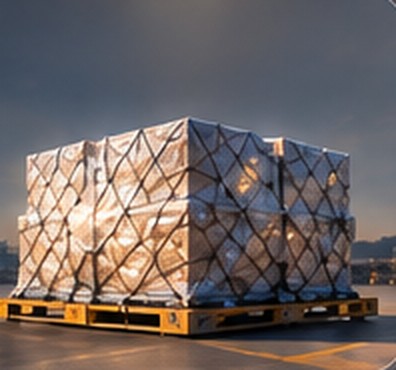
The calculation method involves determining moments of force. A moment is the product of the cargo weight and the "arm" (the distance from a reference point on the aircraft to the pallet's installation location). The sum of all moments divided by the total weight gives the center of gravity coordinate. If you are transporting oversized equipment or heavy machinery, KAZLOGIST.KZ selects a wide-body aircraft in advance and calculates the tie-downs to ensure the heavy object does not shift the center of gravity beyond the critical limit.
How Data Errors Affect Time and Money
When a logistician provides inaccurate weight or dimension data, problems begin at the stage of booking space with partner airlines. KAZLOGIST.KZ frequently encounters situations where the cargo arriving at the warehouse is heavier than declared. This leads to the following consequences:
- CG Shift: If the cargo is heavier, it cannot simply be placed in any free spot. The entire Loadsheet must be recalculated, which can delay departure.
- Offloading: If limits are exceeded, the airline may refuse to carry part of the shipment.
- Price Changes: We remind you that airlines charge based on the greater of actual or volumetric weight. Formula: Length × Width × Height (cm) / 6000.
Balancing Specifics for Different Cargo Types
Different categories of goods require an individual approach to balancing. KAZLOGIST.KZ organizes door-to-door deliveries and considers these specifics:
- Dangerous Goods (DGR): Lithium batteries or reagents are placed according to IATA DGR requirements, often in special zones, which limits balancing options for the rest of the cargo.
- Temperature-Sensitive Cargo: Thermal containers require priority handling and are often placed near the doors for quick unloading, which is also factored into the balance calculation.
- Oversized Cargo: Distributed over the structural elements of the cabin floor to prevent airframe deformation and maintain aircraft stability.
Practical Recommendations for Shippers
To ensure air delivery to Kazakhstan proceeds without delays—usually taking 2 to 8 days depending on the region—follow KAZLOGIST.KZ rules: first, provide the final packing list before the cargo is picked up from the sender; second, indicate the exact center of gravity for oversized crates (marking on packaging); third, do not change cargo parameters after the space is booked. We handle export clearance, AWB verification, and consolidation, but the foundation of flight safety is the accuracy of your data.
If you need to deliver a commercial batch of goods or equipment, KAZLOGIST.KZ specialists will help prepare all documents and calculate the optimal route. Contact us to get an accurate calculation of the cost and timing for your shipment.